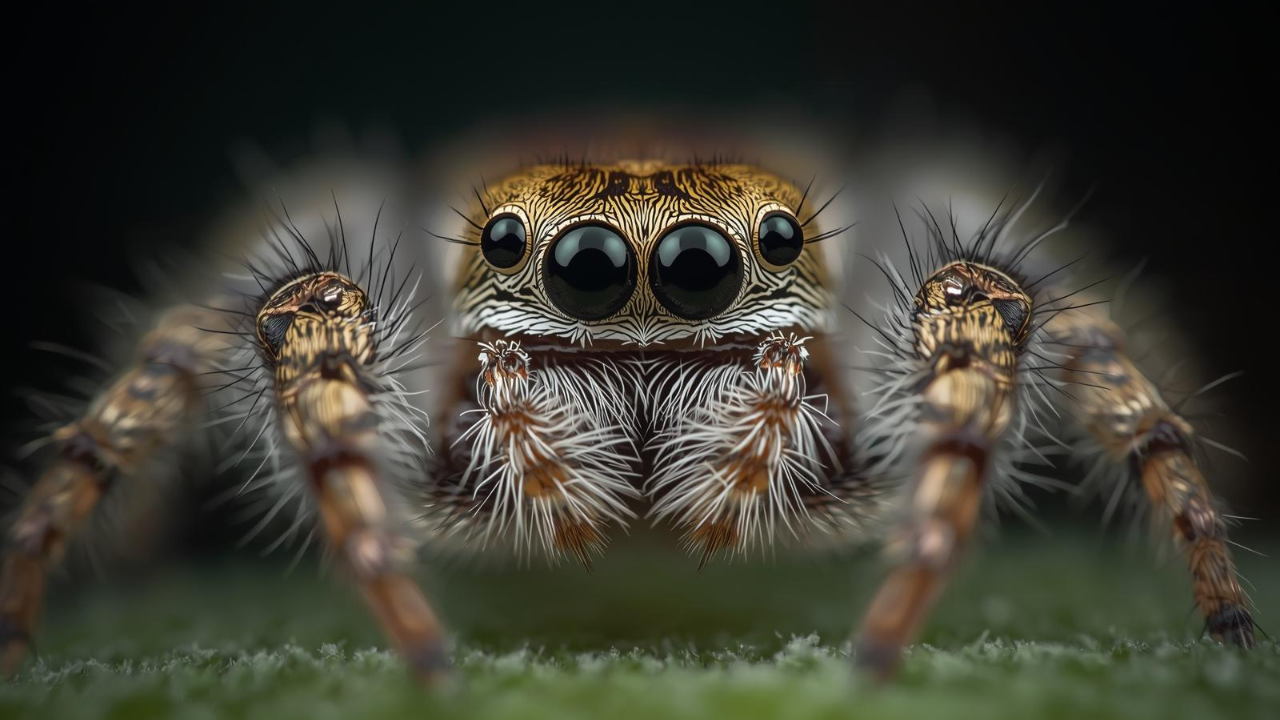
The Jumping Spider Face is one of the most fascinating sights in nature. Unlike most spiders, these tiny hunters appear expressive, curious, and almost intelligent. Their forward-facing eyes, compact facial structure, and fine hair details create a look that surprises both scientists and casual observers. Many people who fear spiders feel differently after seeing a close-up of its face.

This article explores the science, beauty, and surprising facts behind the Jumping Spider Face. From eye structure to behavior, every section explains why this tiny creature has gained massive attention online, in research, and among pet keepers. The goal is to help readers understand, appreciate, and emotionally connect with this incredible spider.
Structure and Overall Anatomy of Its Face
The face of this spider is compact yet highly advanced. Unlike flat-faced spiders, jumping spiders have a raised facial region that supports their powerful eyes. This structure allows them to scan surroundings, track prey, and respond to movement with precision.
Key facial anatomy features include:
- Short, strong chelicerae (mouthparts)
- Dense facial hairs
- Rounded head shape
- Forward-facing eye alignment
This design improves hunting accuracy and depth perception. Evolution has shaped the Jumping Spider Face for visual dominance rather than web dependence.
Its Eye Arrangement
One of the most surprising facts about this spider’s face is its eye system. Jumping spiders have eight eyes, but four are positioned prominently on the face. The large central eyes are responsible for sharp vision.
Eye Arrangement Benefits:
- Superior depth perception
- Ability to recognize shapes
- Excellent motion detection
These eyes work together to give the spider near-360° awareness. The Jumping Spider Face is considered one of the most visually advanced among arthropods.
Facial Hairs and Sensory Details
Facial hairs on this spider are not decorative. These fine hairs act as sensory tools that detect air movement, vibration, and proximity. They help the spider react instantly to threats or prey.
Facial hair benefits include:
- Environmental awareness
- Enhanced balance
- Sensory communication
This combination of hair and vision creates a face that feels alive and alert.
Expressions and Behavior
The Jumping Spider Face appears expressive due to eye movement and head tilting. While spiders do not feel emotions like humans, their behavior mimics curiosity and attention.
Common facial behaviors include:
- Eye tracking
- Head rotation
- Pause-and-stare motion
These behaviors make its face appear friendly and intelligent, contributing to its popularity.
Comparison With Other Spider Faces
Compared to other spiders, the Jumping Spider Face stands out dramatically. Most spiders have small, side-positioned eyes and flat faces. Jumping spiders evolved a more interactive facial structure.
| Feature | Jumping Spider Face | Other Spiders |
|---|---|---|
| Eye Size | Large | Small |
| Vision | Sharp | Limited |
| Face Shape | Rounded | Flat |
| Expression | Apparent | Minimal |
This difference explains why the Jumping Spider Face is less feared.
Color Variations
The Jumping Spider Face comes in a variety of colors depending on species. Common shades include black, green, bronze, and metallic tones. Some species show bright markings that enhance visual appeal.
Color variations help with:
- Mate attraction
- Species identification
- Environmental adaptation
Lighting conditions can dramatically change how a close-up of the Jumping Spider Face appears.
Facts That Truly Surprise Scientists
Scientists are still discovering new abilities of the Jumping Spider Face. Research shows it can recognize patterns, focus on objects, and even respond differently to humans versus insects.
Surprising facts:
- Can track camera lenses
- Can focus eyes independently
- Can remember visual cues
These discoveries continue to reshape how we view spider intelligence.
Macro Photography Tips
Macro photographers love capturing the Jumping Spider Face due to its detail and symmetry. The face photographs beautifully under natural light.
Photography tips:
- Use soft lighting
- Focus on central eyes
- Capture head tilt moments
This helps spread positive awareness about the Jumping Spider Face.
In the Pet Spider Community
Pet keepers often notice bonding moments through observing this spider’s face. While spiders don’t bond emotionally, consistent interaction improves tolerance.
Healthy facial signs:
- Clear eyes
- Clean hairs
- Active movement
A well-cared Jumping Spider Face displays vibrant features.
Common Myths
Many myths surround spiders, but the Jumping Spider Face helps break them.
- “They are aggressive” → False
- “They can’t see humans” → False
- “All spiders look scary” → False
Education changes perception
Evolutionary Advantages
The Jumping Spider Face evolved to support active hunting. Instead of webs, jumping spiders rely on vision and precision jumps.
Advantages include:
- Faster reaction time
- Improved hunting success
- Better survival rates
This explains their global distribution.
Scientific Research on Vision
Studies show the Jumping Spider Face supports complex visual processing. Researchers test this by tracking eye movement and response patterns.
Scientific importance:
- Vision research
- Robotics inspiration
- Behavioral studies
Jumping spiders contribute to modern science.
Conclusion
The Jumping Spider Face is far more than an attractive feature it reflects millions of years of evolution, sharp intelligence, and remarkable adaptability. From its powerful eyes to its expressive movements, this tiny face tells a story of survival, precision, and awareness. Learning about the Jumping Spider Face helps replace fear with curiosity and respect. Observing closely reveals the balance of beauty and function in nature. Even the smallest creatures can leave a powerful impression and deserve thoughtful attention.