
Jumping Spider Face Facts: Eyes, Vision & Secrets Revealed
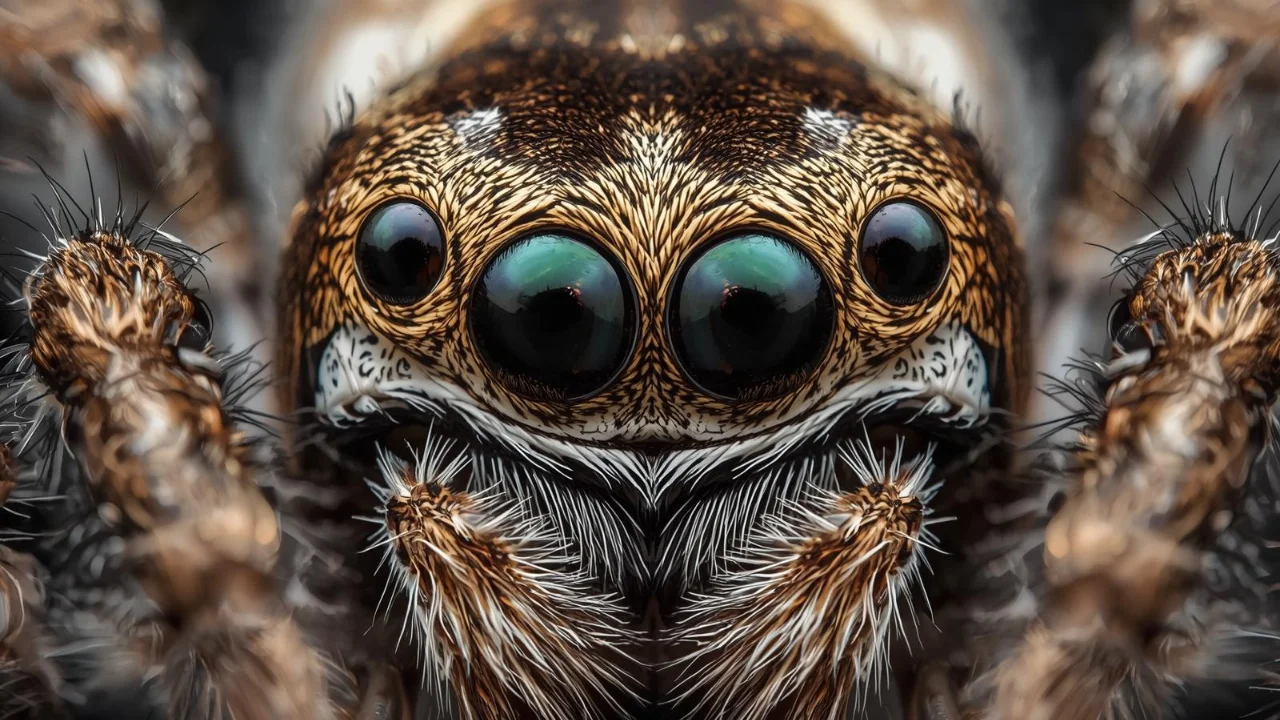
The Jumping Spider Face is one of the most fascinating structures in the insect world. Unlike most spiders that rely on vibration or touch, jumping spiders depend heavily on vision. Their face is dominated by large forward-facing eyes, which give them a unique appearance and exceptional hunting ability.
In this guide, we will explore how the Jumping Spider Face works, why their eyes are so powerful, and what makes their vision system one of the most advanced in the arachnid family. Additionally, we will break down real scientific insights in a simple and user-friendly way.
For example, researchers in the USA have studied jumping spiders in natural environments like gardens, forests, and suburban areas. These studies show that their facial structure is not just unusual, but also highly efficient for survival. As a result, they can detect movement from long distances and react instantly.
Additionally, jumping spiders are not dangerous to humans. Instead, they play an important role in controlling insect populations. Therefore, understanding the Jumping Spider Face helps us appreciate their ecological value and intelligence.
- They have some of the sharpest vision among spiders
- Their face contains 8 eyes arranged in a unique pattern
- They rely more on sight than vibration
- They are widely studied in the USA for vision science research
In the next section, we will break down how many eyes jumping spiders actually have and how each eye contributes to their survival. This will help you understand why their face structure is so important in the natural world.
How Many Eyes Are on a Jumping Spider Face?
The Jumping Spider Face is instantly recognizable because of its unique eye arrangement. Unlike most spiders, jumping spiders have a total of eight eyes. However, not all eyes serve the same purpose.
In fact, their eyes are divided into two main groups: large front-facing eyes and smaller side eyes. Additionally, each pair plays a different role in helping the spider survive in the wild. As a result, they can see both near and far objects with impressive clarity.
For example, researchers in the USA have observed jumping spiders in gardens and forests using their front eyes like telescopes. On the other hand, the smaller eyes help detect movement from the sides, which improves safety and awareness.
Therefore, the Jumping Spider Face works like a multi-lens visual system. It is not just simple vision; instead, it is a highly advanced biological design that supports hunting, navigation, and survival.
Eye Arrangement Breakdown
- Anterior Median Eyes (Front Big Eyes): Provide sharp, detailed vision
- Anterior Lateral Eyes: Assist in depth perception
- Posterior Eyes: Detect motion and side activity
- Total System: Works together for 360-degree awareness
Why This Eye Structure Is Important
Additionally, this eye structure allows jumping spiders to judge distance before jumping. For example, they can calculate exact landing points when attacking prey. Therefore, their survival rate is much higher compared to many other small predators.
On the other hand, most insects and spiders rely on vibration rather than vision. However, jumping spiders depend heavily on their eyes, making their face one of the most advanced in the spider world.
Quick Comparison Table: Jumping Spider Eyes vs Other Spiders
| Feature | Jumping Spider | Typical Spider |
|---|---|---|
| Number of Eyes | 8 | 8 |
| Vision Quality | High-resolution, detailed | Low, mostly light detection |
| Main Sense Used | Vision | Vibration |
| Hunting Style | Active stalking & jumping | Web trapping |
In the next section, we will explore why their eyes are so powerful and how the Jumping Spider Face gives them almost “camera-like” vision in the animal kingdom.
Why Jumping Spider Eyes Are So Powerful
The Jumping Spider Face is not just unusual in appearance, it is also one of the most advanced vision systems in the arthropod world. Unlike many spiders that rely on touch or vibration, jumping spiders depend heavily on their eyesight to survive, hunt, and explore their environment.
In fact, their front eyes function almost like high-resolution cameras. Additionally, they can focus on objects with surprising accuracy. As a result, they are capable of detecting even the smallest movements from a considerable distance.
For example, field studies in the USA have shown that jumping spiders can track prey movement in real time. Moreover, they can judge distance before making a jump, which increases their hunting success rate significantly.
Therefore, the Jumping Spider Face is not just for appearance. Instead, it is a highly evolved survival tool that combines depth perception, motion detection, and precise focus in a single system.
What Makes Their Vision So Advanced?
- High-resolution front eyes: Provide sharp and detailed images
- Layered eye system: Different eyes handle different visual tasks
- Motion sensitivity: Detect even slight movement instantly
- Depth perception: Helps them calculate jumping distance
Comparison with Other Insects
Additionally, most insects rely on compound eyes, which provide wide but blurry vision. On the other hand, jumping spiders have a more focused visual system. Therefore, they can recognize shapes, track targets, and react faster than many other small predators.
For instance, a house spider may detect movement but cannot clearly identify objects. However, jumping spiders can visually confirm prey before attacking. As a result, their hunting strategy is more accurate and energy-efficient.
Scientific Importance of Their Vision
In addition, scientists in neuroscience and robotics study jumping spider vision to improve artificial vision systems. For example, their ability to process visual information with limited brain size is highly efficient. Therefore, it inspires advancements in AI-based image recognition and robotics navigation.
On the other hand, their vision system is still not fully understood. Researchers continue to study how the Jumping Spider Face processes multiple visual inputs at once.
In the next section, we will explore how this powerful vision helps them hunt with incredible precision in the wild.
How the Jumping Spider Face Helps in Hunting
The Jumping Spider Face plays a critical role in one of the most impressive hunting systems in the spider world. Unlike web-building spiders, jumping spiders actively hunt their prey. Therefore, their vision and facial structure are directly linked to survival success.
In fact, their large front eyes allow them to lock onto prey with extreme precision. Additionally, they can calculate distance before making a jump. As a result, their attacks are fast, accurate, and highly controlled.
For example, observations in the USA show that jumping spiders often stalk insects for several seconds before attacking. Moreover, they adjust their position based on movement, lighting, and distance. This level of planning is rare in such small creatures.
Therefore, the Jumping Spider Face is not just a sensory tool, but also a strategic hunting system. It helps them analyze, predict, and execute movements efficiently.
Step-by-Step Hunting Process
- 1. Detection: Side eyes detect motion in the environment
- 2. Focus: Front eyes lock onto the target
- 3. Calculation: Spider estimates distance and angle
- 4. Positioning: It slowly moves closer without alerting prey
- 5. Jump Attack: Final precise leap to capture prey
Why Their Hunting Style Is Unique
Additionally, jumping spiders do not rely on webs like many other species. Instead, they actively chase their prey. On the other hand, this requires more energy and precision, which is why their vision must be extremely advanced.
For instance, a missed jump could mean lost energy or escaping prey. Therefore, the Jumping Spider Face helps ensure accuracy before every attack. In fact, they often test distances multiple times before jumping.
Real-World Observation Insights
Furthermore, researchers have observed that jumping spiders can adapt their hunting behavior based on environment. For example, in open spaces, they rely more on visual tracking. However, in dense areas, they use slow and cautious movement.
As a result, their success rate remains consistently high across different habitats. This adaptability is one reason why they are widely studied in behavioral science.
In the next section, we will break down the actual structure of the Jumping Spider Face in a simple and beginner-friendly way.
Jumping Spider Face Structure Explained Simply
The Jumping Spider Face may look small, but its structure is highly complex and efficient. Unlike humans or mammals, spiders do not have a traditional face. Instead, their facial area is mainly formed by the front part of the cephalothorax, where all eight eyes are positioned.
Additionally, this compact structure allows jumping spiders to combine multiple sensory inputs in a very small space. As a result, they can process visual information quickly and respond instantly to movement around them.
For example, studies in the USA show that even with a tiny brain, jumping spiders can interpret depth, distance, and motion with high accuracy. Therefore, their face structure is a key part of their survival system.
On the other hand, most other spiders have simpler eye arrangements and rely more on vibration. However, jumping spiders depend heavily on their facial design for hunting and navigation.
Main Parts of the Jumping Spider Face
- Front Large Eyes: Provide sharp and focused vision
- Secondary Eyes: Detect movement and side activity
- Cephalothorax Front: Supports eye placement and structure
- Visual Processing System: Combines all eye input into one image
Why Their Face Looks So Unique
Additionally, the large forward-facing eyes give jumping spiders a “cute” or “alert” appearance. However, this is not just for looks. Instead, it reflects their dependence on vision-based hunting.
For instance, the front eyes are so powerful that they can zoom in on objects like a camera lens. Therefore, the Jumping Spider Face functions more like a biological optical system than a traditional face.
How Their Brain Processes the Face Input
Moreover, each eye sends separate visual data to the spider’s brain. Then, the brain combines these inputs into a single image. As a result, they can understand depth, motion, and direction simultaneously.
In fact, this system is so efficient that scientists study it for robotics and artificial intelligence development. Therefore, the jumping spider is not only important in biology but also in technology research.
In the next section, we will explore interesting and lesser-known facts about the Jumping Spider Face that many people don’t know.
Interesting Jumping Spider Face Facts You Didn’t Know
The Jumping Spider Face hides many surprising secrets that most people never notice. Although these spiders are small, their visual abilities and behavior are far more advanced than expected. Additionally, scientists continue to discover new facts about their unique facial structure and vision system.
For example, studies in the USA show that jumping spiders are capable of recognizing patterns and tracking movement with surprising accuracy. As a result, they behave more intelligently than many other arachnids.
Moreover, their face is not just for hunting. Instead, it also helps them interact with their environment, avoid predators, and explore safely. Therefore, the Jumping Spider Face is both a survival and navigation tool.
Fascinating Facts About Jumping Spider Faces
- They can visually track moving objects with high precision
- Their front eyes can zoom in like a camera lens
- Some species can recognize shapes and patterns
- They can judge distance before making a jump
- They use different eyes for different visual tasks
Surprising Behavioral Abilities
Additionally, jumping spiders often appear curious. For instance, they may turn their body to observe objects directly with their front eyes. This behavior shows how important vision is in their daily life.
On the other hand, most spiders avoid direct visual attention and rely on vibration. However, jumping spiders actively use their face to analyze surroundings in real time.
Human Interaction Observations
In fact, researchers have observed that jumping spiders sometimes respond to human movement. For example, they may turn toward motion or pause to observe. Therefore, their visual system is highly responsive and adaptive.
Additionally, their expressive face often makes them appear “curious” or “watchful,” which increases public interest in them. As a result, they are one of the most popular spiders in educational wildlife content.
Why These Facts Matter
Moreover, understanding these facts helps researchers improve studies in vision science and robotics. For example, their small yet powerful visual system inspires AI-based image processing models.
Therefore, the Jumping Spider Face is not just biologically interesting but also scientifically valuable.
In the next section, we will answer an important question: Are jumping spiders dangerous to humans?
Are Jumping Spiders Dangerous to Humans?
Understanding the Jumping Spider Face also helps us learn about their behavior toward humans. Many people assume all spiders are dangerous, however jumping spiders are actually harmless to humans in most cases.
In fact, they are among the least aggressive spider species. Additionally, they do not build webs to trap humans or large animals. Instead, they focus on hunting small insects like flies and ants. As a result, they rarely interact negatively with people.
For example, in the USA, jumping spiders are commonly found in gardens, homes, and outdoor walls. Despite their presence, incidents of bites are extremely rare. Moreover, when bites do occur, they are usually mild and comparable to a small insect sting.
Therefore, the Jumping Spider Face is designed more for observation and hunting insects rather than defense against humans. On the other hand, they prefer avoiding large creatures altogether.
Do Jumping Spiders Bite Humans?
- Bites are extremely rare and usually accidental
- They are not aggressive toward humans
- Most bites cause mild irritation only
- They prefer escaping rather than attacking
Why They Are Not Dangerous
Additionally, jumping spiders do not possess strong venom that can harm humans. Instead, their venom is designed for small prey. Therefore, even if a bite occurs, it is not medically significant for most people.
Moreover, their vision system helps them identify threats early. As a result, they often retreat before any contact happens. This makes them one of the most harmless spider types found in homes and gardens.
Human Behavior Observations
For example, researchers have noticed that jumping spiders sometimes appear curious about humans. However, this behavior is related to their advanced vision system, not aggression.
On the other hand, they may quickly jump away if they feel threatened. Therefore, their behavior is defensive rather than offensive.
Safety Summary
In conclusion, jumping spiders are beneficial creatures that help control insect populations. Additionally, they play an important role in maintaining ecological balance. The Jumping Spider Face is built for precision hunting, not human interaction.
In the next section, we will explore how scientists study jumping spider vision and why it is important in modern research.
Why Scientists Study Jumping Spider Vision
The Jumping Spider Face is not only fascinating for nature lovers but also highly important in scientific research. In fact, scientists in the USA and other countries study jumping spiders to better understand vision, behavior, and even artificial intelligence systems.
Additionally, their eyes are one of the most advanced visual systems found in small animals. As a result, researchers use them as a model to study how complex vision can exist in a very small brain.
For example, laboratory studies show that jumping spiders can process visual information quickly and accurately. Moreover, they can track movement, judge distance, and react instantly. Therefore, they are extremely useful in neuroscience and robotics research.
On the other hand, most insects rely on simple visual systems. However, the Jumping Spider Face offers a multi-layered vision system that works almost like a natural camera setup.
Key Areas of Scientific Study
- Vision Processing: How spiders combine multiple eye inputs
- Behavioral Science: How they decide to hunt or avoid danger
- Neuroscience: How a small brain processes complex visuals
- Robotics & AI: Inspiration for machine vision systems
Why Their Vision Is Important for Technology
Additionally, engineers study jumping spider vision to improve camera systems and artificial intelligence. For instance, their ability to focus only on important visual details helps reduce unnecessary data processing in machines.
Therefore, the Jumping Spider Face has become a model for designing smarter robots and better visual sensors. In fact, some AI systems now mimic how spiders filter visual information.
Real-World Research Examples
For example, researchers have observed that jumping spiders can detect movement patterns even in noisy environments. Moreover, they can ignore irrelevant motion and focus only on prey-like movement.
As a result, this selective attention system is being studied for autonomous vehicles and drone navigation technologies.
Scientific Importance Summary
In conclusion, the jumping spider is more than just a tiny predator. Instead, it is a biological inspiration for future technology. The Jumping Spider Face continues to help scientists understand how vision and intelligence can work efficiently in small systems.
In the next section, we will guide readers toward exploring more spider-related content and learning resources.
Explore More About Jumping Spider Face Facts
Now that you understand the incredible Jumping Spider Face, its vision system, and hunting abilities, you can explore even more fascinating spider insights on our website. These tiny creatures are not only unique but also play an important role in nature and science.
Additionally, learning about jumping spiders helps you understand how vision and behavior work together in one of nature’s most advanced small predators. As a result, you gain a deeper appreciation of their intelligence and survival skills.
For example, you can discover how jumping spiders behave in different environments, how they interact with humans, and what makes their bite harmless in most cases. Moreover, you can explore identification guides and color variations found in the USA.
Why You Should Keep Exploring
- Learn how different jumping spider species behave
- Understand their role in controlling insect populations
- Discover their unique colors and patterns in the USA
- Explore safety and bite-related facts in detail
Therefore, if you are curious about nature, spiders, or science, this is the perfect place to continue your journey. The more you learn, the more fascinating the Jumping Spider Face becomes.
Additionally, our guides are written in a simple and beginner-friendly way, so anyone can understand even complex spider biology easily.
Start exploring more articles now and dive deeper into the world of jumping spiders. You will find surprising facts, helpful guides, and science-backed information designed for readers in the USA and beyond.
Keep learning, keep exploring, and uncover the hidden world of jumping spiders today.
Frequently Asked Questions About Jumping Spider Face Facts
1. Why do jumping spiders have such a unique face?
Jumping spiders have a unique face because their front body is designed for advanced vision. Their large front eyes give them sharp focus, while smaller eyes detect movement. As a result, they can hunt with high precision.
2. How many eyes are on a jumping spider face?
A jumping spider has eight eyes in total. Additionally, each pair serves a different purpose such as motion detection, depth perception, and sharp forward vision.
3. Can jumping spiders see humans clearly?
Yes, jumping spiders can detect humans through their advanced vision system. However, they do not see humans in detail like we see them. Instead, they recognize shapes, movement, and general size.
4. Are jumping spiders dangerous to humans?
No, jumping spiders are not dangerous to humans. In fact, they are harmless in most cases. Their venom is only used for small insects and does not cause serious harm to people.
5. Why are jumping spider eyes so big?
Their large front eyes allow them to see clearly and judge distance accurately. Therefore, they can successfully hunt prey by calculating exact jumping angles.
6. Do jumping spiders rely only on vision?
Mostly yes. Unlike many spiders, jumping spiders depend heavily on vision instead of vibration. However, they still use other senses for environmental awareness.
7. Where are jumping spiders commonly found in the USA?
Jumping spiders are commonly found in gardens, walls, plants, and outdoor areas across the USA. Additionally, they are often seen in warm and sunny environments.
Conclusion: The Amazing World of Jumping Spider Face Facts
The Jumping Spider Face is one of nature’s most advanced and fascinating biological designs. From their powerful vision system to their precise hunting abilities, these tiny spiders demonstrate how complex intelligence can exist in a small body.
Additionally, their eight-eye system allows them to see the world in a completely different way. As a result, they can detect movement, calculate distance, and capture prey with remarkable accuracy. This makes them one of the most successful small predators in nature.
For example, studies in the USA show that jumping spiders are not only efficient hunters but also important contributors to natural pest control. Therefore, they play a valuable role in maintaining ecological balance.
Moreover, understanding the Jumping Spider Face helps us appreciate how evolution has shaped unique survival strategies. On the other hand, their harmless nature toward humans makes them safe and beneficial creatures to observe.
In conclusion, jumping spiders are more than just small arachnids. Instead, they are intelligent, visually advanced hunters that continue to inspire science and technology. Exploring their world gives us deeper insight into nature’s hidden complexity.
Keep learning more about jumping spiders to discover even more surprising facts about their behavior, vision, and unique adaptations.
