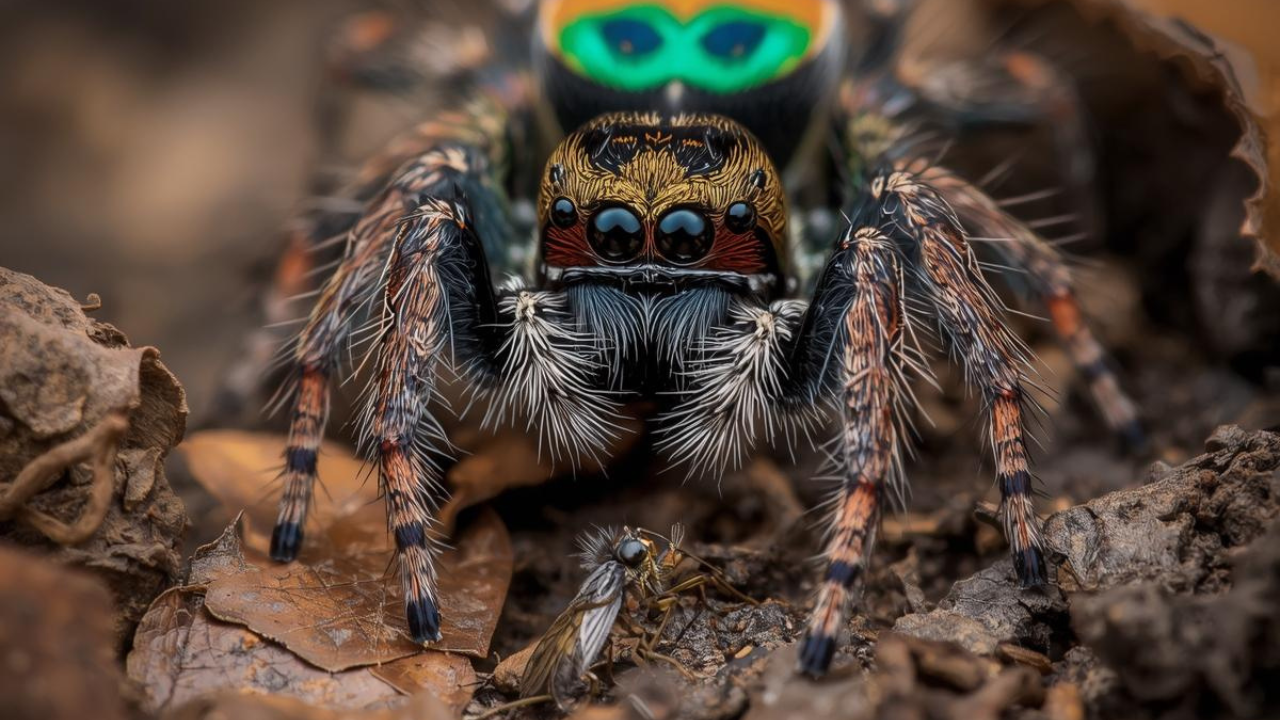
With my professional experience studying jumping spiders, I can confidently say that the Evarcha arcuata jumping spider is a particularly intriguing species because of its adaptability and relatively quiet presence in natural habitats. It is found across a range of landscapes in southern and central parts of England, with notable records from Staffordshire, Shropshire, Yorkshire, and Cardiganshire. The species also appears in scattered regions of north-western Europe, showing its ability to adjust to different climates and environments.
Historical observations, including a significant record from 1999 at Hatfield Moors, help researchers understand how this spider may slowly extend its range over time. Interestingly, despite its broad European presence, it has never been documented in Ireland, which adds another layer of curiosity for researchers studying its distribution. These collective sightings give us a more complete and evolving picture of how the species survives, adapts, and maintains a steady yet subtle presence across diverse landscapes.

Habitat and Ecology of Evarcha arcuata jumping spider
The Evarcha arcuata jumping spider thrives in natural environments where moisture and vegetation create perfect hunting spots. It often appears around damp areas, patches of bog, and wide stretches of heathland, including dry heathland with scattered scrub or shrubby vegetation. Adults become more active from May to August, while males sometimes continue into September and October, taking advantage of seasonal shifts. Whether perched on low plants or scanning open ground, E. arcuata uses its agility and awareness to navigate these habitats with precision.
Threats to the Evarcha arcuata jumping spider
With my professional experience studying jumping spiders, I can say that the Evarcha arcuata jumping spider faces growing challenges due to human activities and environmental changes. The loss of heathland to agriculture, afforestation, and development has significantly reduced suitable habitats. Most of Hatfield Moors has already been destroyed, and ongoing peat exploitation affects the surrounding areas.
Additionally, drainage of the nearby land has lowered the water table, putting the lowland raised mire in imminent danger of being completely lost to woodland. The remaining small refuge for the species is now isolated, limiting its ability to hunt and reproduce. These environmental pressures threaten the stability of populations, making conservation of these delicate habitats crucial for the survival of the Evarcha arcuata jumping spider.
Male Evarcha arcuata jumping spider
Having observed jumping spiders closely, I can describe the male Evarcha arcuata jumping spider in detail. Based on careful observation, the male palp features a strongly sclerotised embolic part, while the Tibial apophysis is straight and pointed, often dark coloured. The Prosoma is black-brown, bright haired on median and lateral parts, with the anterior margin showing small white hairs. The Opisthosoma has a dark median stripe and dark transverse stripes, with overall coloration ranging from dark brown to black.
From extensive field measurements, I note that males typically measure a body length of 5.1-6.3 mm, though some reach approximately 4.1-4.9 mm, while females are slightly larger at 4.8-5.8 mm. The male cephalothorax shows white marginal stripes and a white median stripe, with the clypeus covered in white scales. The opisthosoma is dark brown to black dorsally, decorated with white lateral stripes that curve inward posteriorly forming an arched pattern, while the venter appears dark gray to black. This combination of features makes the Evarcha arcuata jumping spider visually distinctive and easy to identify in the wild.
Female Evarcha arcuata jumping spider
Having closely observed jumping spiders over the years, I can describe the female Evarcha arcuata jumping spider in detail. The female cephalothorax is yellow-brown with white marginal stripes and a less distinct median stripe. The clypeus has sparse white scales, while the opisthosoma is yellow-brown dorsally with a pattern of white markings and dark markings forming chevron-like designs. The venter ranges from yellow-brown to gray, giving the spider a distinctive appearance.
Both sexes have legs that are yellow-brown with darker annulations, and the pedipalps in males are dark brown to black, while in females they remain yellow-brown. The epigyne is broad at the epigastric furrow and roughly quadrangular. The body length of the female is about 7.0 mm, making the Evarcha arcuata jumping spider slightly larger than the male and easily recognizable in its natural habitat.
Taxonomy of the Evarcha arcuata jumping spider
With my professional experience studying spiders, I can explain the taxonomy of the Evarcha arcuata jumping spider. The species was originally described by Carl Alexander Clerck in 1757 as Araneus arcuatus in his work Svenska Spindlar. Over time, it has been listed under numerous synonyms, reflecting the complex taxonomic history of jumping spiders and the confusion that arose from early taxonomic work, when spider classification was not fully established.
The species is now placed in the genus Evarcha, established by Eugène Simon in 1902. The extensive synonymy list highlights the wide distribution of the Evarcha arcuata jumping spider and shows how independent descriptions were made by various authors in different regions. This history demonstrates the evolving understanding of this remarkable species and its classification within the jumping spider family.
FAQs
What is the common name for Evarcha arcuata?
Based on my professional experience observing spiders, the Evarcha arcuata jumping spider is known by several common names. It is most often called the Arched Jumping Spider or the Metallic Jumping Spider, but it is also sometimes referred to as the Bowed Jumping Spider or the Gorilla Jumping Spider.The name arched comes from the curved pattern found on the spider’s abdomen, which makes it visually distinctive. These common names help enthusiasts and researchers alike to identify the Evarcha arcuata jumping spider easily in the wild and communicate about it effectively across different regions.
Where is Evarcha arcuata found?
Evarcha arcuata jumping spider is primarily found in southern and central England, including regions like Staffordshire, Shropshire, Yorkshire, and Cardiganshire. Beyond the UK, it also occurs in parts of north-western and central Europe, thriving in areas with suitable heathland, damp environments, and low shrubby vegetation. Despite its wide European presence, it has never been recorded in Ireland, which makes its distribution particularly interesting for researchers and spider enthusiasts alike.
What do Evarcha arcuata jumping spiders eat?
From my professional experience observing spiders, Evarcha arcuata jumping spiders are polyphagous predators that feed on a variety of small arthropods, including various insects and other spiders. They are active, diurnal hunters that rely on their acute vision to stalk and pounce on prey, rather than capturing it in a web.In the wild, their diet commonly includes flies, mosquitoes, aphids, grasshoppers, moths, and other small spiders. This diverse feeding habit allows the Evarcha arcuata jumping spider to adapt to different habitats and maintain its role as an efficient predator in its ecosystem.
Conclusion
The Evarcha arcuata jumping spider is a fascinating and remarkable species, celebrated for its distinctive appearance, agile hunting skills, and adaptability to a variety of environments. This species is primarily found in southern and central England, including regions like Staffordshire, Shropshire, Yorkshire, and Cardiganshire, and extends to parts of north-western and central Europe. It thrives in heathlands, damp areas, bogs, and low shrubby vegetation, where it actively hunts a wide range of small arthropods. Both males and females display unique physical traits, with males showing dark stripes and bright hairs and females featuring chevron-like markings on the abdomen.
As polyphagous predators, they feed on flies, mosquitoes, aphids, grasshoppers, moths, and other small spiders, making them important for maintaining ecological balance. Despite their resilience, the Evarcha arcuata jumping spider faces threats from habitat loss, drainage, and human development, highlighting the urgent need for conservation efforts. Studying their taxonomy, behavior, diet, and habitat preferences offers essential insights for researchers and enthusiasts alike.