
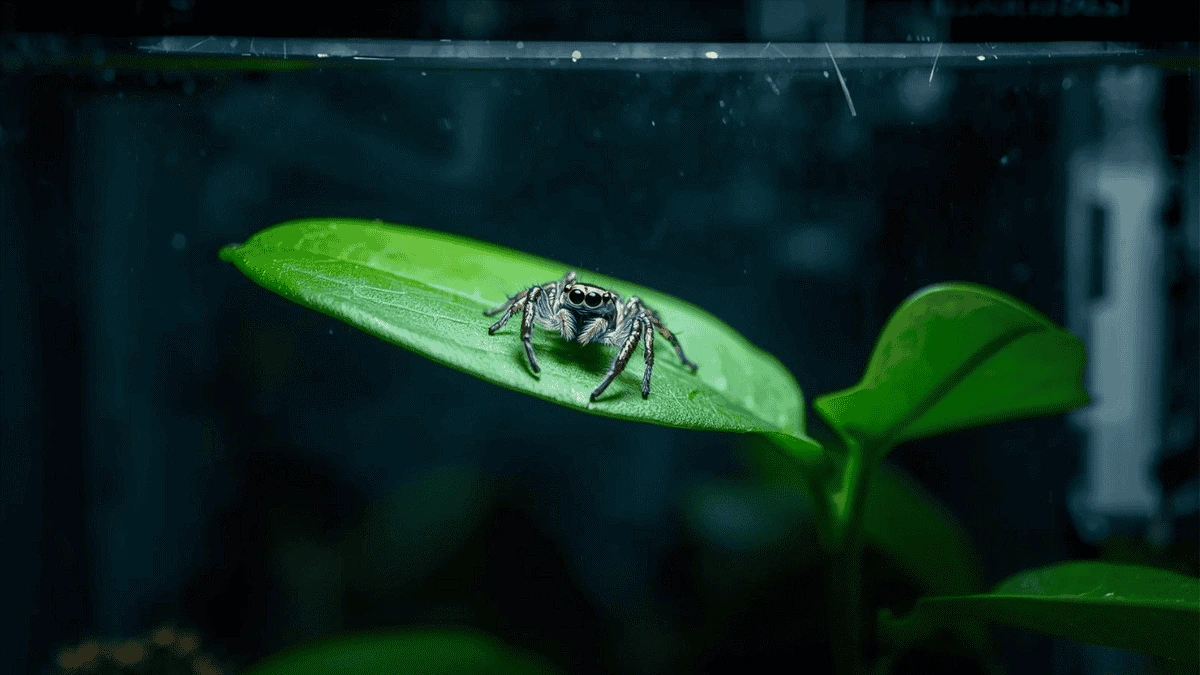
Lighting in the Health of Jumping Spiders.
Most individuals who build a jumping spider enclosure will consider food, decoration and humidity, but will not consider one important aspect of it all, which is the lighting.
Here’s the reality:
When your spider is not on the move, is not feeding, or is in hiding all the time, the cause is often concealed in lighting.
Jumping spiders are very visual animals. The way they behave, the ability of hunting and even the life span is directly dependant on the way you are able to replicate the conditions of natural lighting in the indoors.
This guide is divided into the things you need to know, whether it is a simple set up or full optimization; your spider will stay active, healthy and prosperous.
The reasons why proper lighting is a necessity to jumping spider behavior and health.
The jumping spiders are quite unlike the web-building spiders. They do not sit and wait, they go in pursuit.
This implies that they are more reliant on:
Sharp vision
Movement detection
Bright environments
In the wild, they spend most of the day in natural daylight, something that enables them to:
Spot prey easily
Navigate their surroundings
Be more on the move and more to the point.
Their whole behaviour is different when there is poor lighting in captivity.
What occurs with bad lighting:
- Reduced hunting activity
- Slower movement
- Increased hiding
- Lower feeding response
- Light does not merely assist–it gets their instincts working.
Issue: Why Is My Jumping Spider Not Jumping or In Hiding?
It is one of the most frequent problems of beginners.
You might notice:
Your spider keeps in a corner.
It avoids open areas
It ignores prey
Inappropriate or inadequate lighting is a problem in most instances.
Jumping spiders require good contrast of color to operate. Dark surroundings disorient their sensory system.
This can be corrected in a hurry:
Replace with a daylight LED bulb (5000K6500K)
Increase brightness gradually
Have a regular light program.
In a few days, the majority of owners observe:
Increased movement, exploration, and improved feeding behaviors.
Lighting in the House vs. Natural Sunlight: What You Should mimic to achieve the best health.
In the wild, jumping spiders inhabit sunny and open-air areas that have no obstructions to sight.
That is eliminated in indoor setups.
Your aim is to imitate:
Bright daylight exposure
Even light distribution
Natural day-night cycle
Why this matters:
Even an ideal enclosure design will not allow natural behavior to occur without adequate lighting.
Consider lighting as the driver to the activity of your spider.
Should Jumping Spiders Have UV Light or LED Light?
It is a question that puzzles any beginning student.
Simple Answer:
Jumping spiders do NOT need UV light to survive or stay healthy.
Unlike reptiles:
- They don’t require UVB for metabolism
- They don’t depend on UV for calcium absorption
What they really require:
- Bright visible light
- Stable lighting routine
- Low heat environment
An excellent LED arrangement is more than sufficient.
Caution: Novice Errors: Heat Lamps vs. proper lighting.
Most of the new keepers are thinking that a heat lamp can substitute natural lighting.
This is a critical mistake.
The reason heat lamps are dangerous:
- They produce excessive heat
- They evaporation dry the enclosure.
- They stress the spider
- Jumping spiders are not heat-dependent animals. They are visual hunters who are light-dependent.
- Better alternative:
- Daylight LED bulb
- Low heat output
- Stable brightness
📊 Light quality: The most important aspect is the quality of light, not the amount it produces.
How to Select the most appropriate lighting system to use in jumping spider enclosures.
It is not difficult to choose the appropriate light when you concentrate on the right factors.
Ideal Lighting Features:
The color temperature of daylight (5000K6500K) extends from 5000K to 6500K.
This resembles the natural sunlight and makes it easier to see.
- Low Heat Emission
Avoids stress and dehydration.
- Even Coverage
The whole enclosure is to be bright–not a single point.
- Energy Efficiency
The lights will be on 10-12 hours a day, hence efficiency is an issue.
Cautionary Advice: Why Lighting directly influences Hunting and Appetite.
When your spider will not eat, it might be due to lighting.
Jumping spiders use movement detection and visual tracking to hunt.
In poor lighting:
- They are incapable of seeing clearly prey.
- No instincts of hunting are aroused.
- Food is ignored
- With proper lighting:
- Hunting becomes active
- Feeding response improves
- The movement is made more accurate.
- Lighting = Feeding behavior
🕒 How to make the ideal Lighting Schedule to promote Healthy Activity Cycles.
Lighting is not merely about being bright, but a matter of time.
The jumping spiders adhere to a day-night cycle.
✔️ Ideal schedule:
- 10–12 hours of light
- 12–14 hours of darkness
Why consistency matters:
- Regulates activity
- Improves feeding patterns
- Reduces stress
Set a timer to keep a consistent habit.
Does Jumping Spider Require Light or Darkness at Night?
They need darkness.
Continuous lighting can:
- Disrupt rest cycles
- Reduce daytime activity
- Increase stress levels
- Darkness allows:
- Proper rest
- Natural rhythm reset
Never keep lights on 24/7
The Effect of Lighting on Growth, Molting and general development.
Lighting does not only influence behavior, it influences growth.
With proper lighting:
- The molting periods stabilize.
- Growth remains consistent
- Physical health improves
- With poor lighting:
- Problems with molting can arise.
- Growth slows down
- Stress increases
Lighting aids in external behaviour and internal health.
Needs of Spiderlings vs Adults with regards to lighting.
The various stages in life demand a little modification of lighting.
- Spiderlings (Babies):
- Need moderate brightness
- Shun direct light that is hard.
- Concentrate on soft lighting.
- Adult Spiders:
- Require brighter lighting
- Take advantage of good visibility.
Be more active.
Vary the intensity of light depending on size and stage.
Warnings Your Jumping Spider Needs More Lighting ASAP.
Be alert to the following red flags:
- Poor activity or slowness.
- Refusal to eat
- Constant hiding
- Dull coloration
- Irregular molting
It is usually the light problems, not the diet problems.
The Lighting Misjudgments that are the most frequent and damaging to Jumping Spiders.
Some of the common novice mistakes to avoid include:
- Using heat lamps for lighting
- Leaving lights on during the day and night.
- Using dim or yellow bulbs
- Having lights too near to each other.
- Not using a timer
Every failure decreases the activity and heightens stress.
ℊ Stepwise To Build the Ideal Lighting System.
It is a very easy procedure:
Step 1:
Select daylight LED bulb (5000K6500K)
Step 2:
Install it 12-18 inches over the enclosure.
Step 3:
Make sure that there is even lighting in the habitat.
Step 4:
Use a timer of 10-12 hours a day.
Step 5:
Monitor behavior and modify, as necessary.
Why Lighting is the least considered aspect in Spider Care.
The majority believes that the most significant aspect of care is food.
But this is the fact:
You can have the best feeding in the dark.
Lighting controls:
- Activity
- Hunting
- Growth
- Behavior
- It is the basis of all things.
Final Thoughts
Always check lighting to make sure your jumping spider is not acting strangely.
Prior to replacement of food or enclosure:
- Fix brightness
- Fix schedule
- Fix placement
