
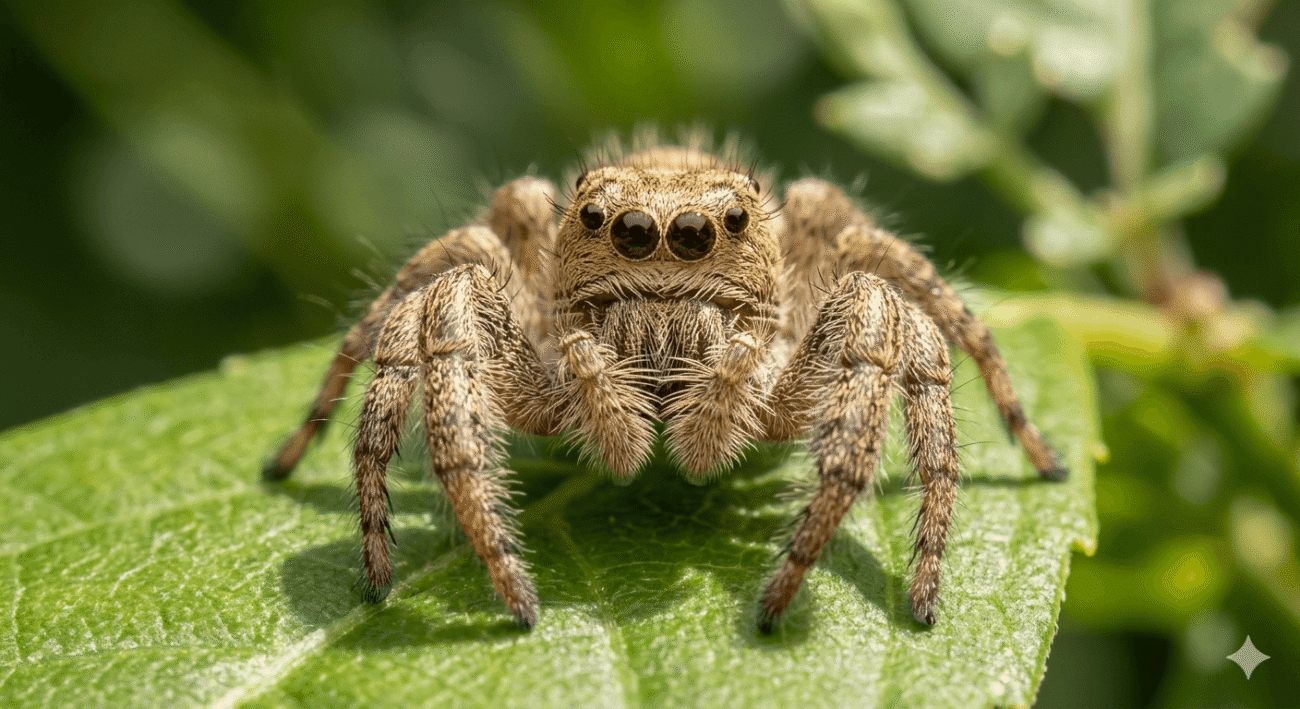
The Tan Jumping Spider is one of the most fascinating small arachnids found across the USA. It is known for its intelligent hunting behavior, excellent vision, and calm interaction with humans. Many spider enthusiasts search for the Tan Jumping Spider because it is harmless and easy to observe in nature or as a beginner-friendly pet.
Additionally, this spider is part of the jumping spider family, which does not rely on webs to catch prey. Instead, it actively hunts using precise jumps and strong eyesight. Therefore, it plays an important role in controlling small insects like flies and gnats.
For example, in many American gardens, people often notice this small spider on walls, plants, or windows. As a result, it is considered a natural pest controller rather than a threat.
In fact, the Tan Jumping Spider is popular among beginners because of its curious behavior and manageable care requirements. However, understanding its habitat, diet, and behavior is essential before interacting with it.
- Small and active hunting spider species
- Found commonly in gardens and homes in the USA
- Harmless to humans in most situations
- Known for strong vision and jumping ability
On the other hand, many people confuse it with dangerous spiders due to its appearance. Therefore, learning proper identification is important for safety and awareness.
This guide will help you understand everything about its size, behavior, habitat, and care needs in detail. Next, we will explore what exactly makes the tan jumping spider unique among other spider species.
The Tan Jumping Spider is a small, active spider species belonging to the Salticidae family. It is widely found across the USA in gardens, walls, fences, and sometimes inside homes. Unlike web-building spiders, it relies on vision and jumping ability to hunt its prey.
Additionally, this spider is known for its curious and alert nature. It often turns toward movement and observes its surroundings carefully. Therefore, many researchers and hobbyists consider it one of the most intelligent spider groups.
For example, when a small insect like a fly comes near, the Tan Jumping Spider calculates distance before making a precise jump. As a result, it rarely misses its target during hunting.
In fact, its excellent eyesight is one of its strongest features. It has multiple eyes that allow it to detect motion from different angles. However, despite its advanced vision, it remains completely harmless to humans.
Natural Habitat in the USA
The tan jumping spider habitat is very flexible, which is why it is commonly seen in many regions of the USA. It prefers warm, dry environments where insects are available.
- Gardens and backyard plants
- Wooden fences and walls
- Window corners and outdoor furniture
- Grasslands and small shrubs
On the other hand, it avoids highly wet or extremely cold areas. Therefore, seasonal changes can affect its visibility outdoors.
Why It Is Harmless
The tan jumping spider venomous concern is common among beginners, but it is not dangerous to humans. Its venom is only used to immobilize small insects.
Additionally, it does not show aggressive behavior unless threatened. Even then, bites are extremely rare and medically insignificant. Therefore, it is considered safe for observation and beginner pet keeping.
In conclusion, this spider is a beneficial and harmless species that helps control insect populations naturally. Next, we will look at its size, appearance, and how to identify it correctly in the wild.
Correct identification of the Tan Jumping Spider is important because many small spiders look similar. However, this species has distinct physical traits that make it easier to recognize once you know what to look for.
Additionally, its compact body structure and active movement help distinguish it from web-building spiders. Therefore, observing behavior along with appearance gives the most accurate identification.
Tan Jumping Spider Size and Body Features
The tan jumping spider size is generally small, but it varies slightly depending on age and sex. Most adults remain tiny compared to common household spiders.
- Average size: 4mm to 12mm
- Compact and slightly furry body
- Strong front legs for jumping
- Short abdomen compared to body length
For example, males are often slimmer and more active, while females appear slightly rounder. As a result, gender differences are noticeable in mature spiders.
Eye Structure and Vision
One of the most unique features is its eye arrangement. The spider has eight eyes, with two large front-facing eyes that provide sharp vision.
In fact, this advanced vision helps the spider judge distance before jumping. Additionally, it can detect movement even from several centimeters away.
Color and Identification Clues
The tan jumping spider coloration is usually light brown, beige, or sandy. However, color may slightly change depending on lighting and environment.
- Tan or light brown body tone
- Dark markings on the face or legs
- Glossy eyes reflecting light
- Quick, jumping movement instead of crawling
On the other hand, many spiders are mistaken for this species due to similar size. Therefore, movement behavior is just as important as appearance for correct identification.
In conclusion, the tan jumping spider is easy to recognize once you focus on its eyes, movement style, and compact body shape. Next, we will explore its behavior and personality traits in detail.
The Tan Jumping Spider is widely admired for its intelligent and curious behavior. Unlike many spiders that remain hidden, this species is active, alert, and highly responsive to movement around it.
Additionally, it does not rely on webs for hunting. Instead, it uses its sharp vision and jumping ability to capture prey. Therefore, its behavior feels more like a small hunter than a typical spider.
Curious and Intelligent Nature
One of the most interesting traits is its curiosity. The spider often turns toward moving objects and watches them closely.
- Responds quickly to movement
- Observes surroundings with focused attention
- Explores surfaces actively
- Appears aware of nearby activity
For example, in many USA homes, people notice it watching them from a wall or plant. As a result, it often appears more interactive than other spiders.
Jumping and Hunting Style
The Tan Jumping Spider is a skilled hunter. It does not build webs to trap prey. Instead, it calculates distance and jumps precisely.
Additionally, it uses silk only as a safety line during jumps. Therefore, it can safely explore vertical and uneven surfaces.
- Stalks prey slowly before attacking
- Uses vision to measure distance
- Jumps with controlled accuracy
- Secures itself with silk threads
Daily Activity Patterns
This spider is mostly active during the day. In fact, it prefers daylight for hunting and exploration.
On the other hand, at night it becomes less active and seeks shelter in small crevices or hidden spaces. Therefore, it is considered a diurnal spider species.
Additionally, it avoids unnecessary confrontation. However, if threatened, it may raise its front legs as a warning posture.
In conclusion, its behavior is calm, intelligent, and highly adaptive. Next, we will explore its natural habitat and where it is commonly found in the USA.
The Tan Jumping Spider is highly adaptable, which is why it is commonly found across different regions of the USA. It thrives in both natural and urban environments where small insects are available for food.
Additionally, this spider prefers warm and moderately dry conditions. Therefore, it is often seen during spring and summer seasons when insect activity is high.
Where You Can Commonly Find It
In everyday environments, the tan jumping spider habitat includes a wide range of locations. It adjusts easily to human surroundings.
- Garden plants and flower pots
- Wooden fences and outdoor walls
- Windows, corners, and door frames
- Grass areas and shrubs
For example, many homeowners in the USA notice it moving on patio furniture or sunny walls. As a result, it is often mistaken for a house spider, even though it prefers open spaces.
Preferred Environmental Conditions
This spider survives best in stable and warm environments. However, it avoids extreme conditions.
- Moderate humidity levels
- Warm temperatures between 20°C to 30°C
- Access to small insects for feeding
- Minimal disturbance or vibration
On the other hand, heavy rain or very cold weather reduces its visibility. Therefore, it often hides during harsh seasonal changes.
Adaptation in Urban Areas
The Tan Jumping Spider has successfully adapted to human environments. In fact, urban areas provide plenty of food sources like flies, ants, and gnats.
Additionally, artificial lighting around homes attracts insects, which indirectly benefits the spider. Therefore, it is frequently found near lights, windows, and outdoor structures.
However, despite living close to humans, it remains non-aggressive and avoids interaction whenever possible.
In conclusion, its flexible habitat preference makes it one of the most commonly observed jumping spiders in the USA. Next, we will explore its diet and feeding behavior in detail.
The Tan Jumping Spider is a skilled hunter that relies on active stalking rather than webs. Its diet mainly consists of small insects, making it an important natural pest controller in many USA gardens and homes.
Additionally, its excellent vision allows it to detect and track prey with precision. Therefore, it can hunt efficiently even in complex environments like plants and walls.
What Does a Tan Jumping Spider Eat?
The Tan Jumping Spider feeds on a variety of small insects. Its diet is simple but highly effective for survival.
- Flies and fruit flies
- Gnats and mosquitoes
- Small ants and tiny beetles
- Occasionally other small arthropods
For example, in many American homes, these spiders help reduce annoying flying insects naturally. As a result, they are often considered beneficial rather than harmful.
Hunting Technique
Unlike web-building spiders, this species actively hunts its prey. It uses patience, precision, and timing.
Additionally, it slowly approaches its target before making a quick and accurate jump. Therefore, it rarely misses once it locks onto prey.
- Uses vision to track movement
- Stalks prey carefully before attacking
- Jumps with controlled force and direction
- Uses silk only for safety lines
In fact, this hunting style is one of the reasons the Tan Jumping Spider is studied for its intelligence and coordination.
Feeding Frequency
The feeding frequency depends on temperature and prey availability. However, most spiders eat every few days.
Additionally, younger spiders tend to feed more frequently due to growth needs. Therefore, their activity level is slightly higher than adults.
On the other hand, if food is scarce, they can survive for some time by conserving energy. This adaptability helps them thrive in different environments.
In conclusion, the tan jumping spider plays an important role in controlling small insect populations. Next, we will explore how to care for it if kept as a pet.
Keeping a Tan Jumping Spider as a pet has become popular among spider enthusiasts in the USA. It is small, low-maintenance, and easy to observe, making it ideal for beginners.
Additionally, understanding proper care is essential for its health and survival. Therefore, setting up the right environment plays a key role in successful keeping.
Enclosure Setup
A simple but secure enclosure is enough for this species. However, ventilation and safety are important.
- Small ventilated container or terrarium
- Secure lid to prevent escape
- Natural twigs or small plants for climbing
- Minimal space with vertical climbing area
For example, many USA hobbyists use small acrylic boxes with air holes. As a result, the spider feels safe while remaining visible for observation.
Feeding in Captivity
The Tan Jumping Spider should be fed live small insects. Additionally, feeding should be controlled to avoid overfeeding.
- Fruit flies (most common food)
- Small crickets or tiny insects
- Feed every 2–3 days
- Remove uneaten prey after feeding
On the other hand, overfeeding can stress the spider or cause health issues. Therefore, moderation is important.
Handling and Safety
Although it is harmless, handling should be minimal. The spider is delicate and can be easily injured.
Additionally, it may jump suddenly if startled. Therefore, observation is better than frequent handling.
- Avoid squeezing or direct pressure
- Let it move freely on surfaces
- Handle only when necessary
Maintenance Tips
Clean enclosure regularly to maintain hygiene. However, avoid disturbing the spider too often.
- Remove leftover insects
- Maintain moderate humidity
- Avoid strong direct sunlight
- Ensure stable temperature
Comparison Table: Tan Jumping Spider vs Other Jumping Spiders
| Feature | Tan Jumping Spider | Other Jumping Spiders |
|---|---|---|
| Color | Light tan or brown | Varies (black, green, colorful) |
| Behavior | Calm and curious | More active or bold depending on species |
| Care Difficulty | Easy | Moderate |
| Size | Small (4–12mm) | Varies widely |
| Pet Suitability | Great for beginners | Some require experience |
In conclusion, the Tan Jumping Spider is one of the easiest spider species to care for, making it perfect for beginners in the USA.
Next, we will explore a real-world comparison with competitors and similar spider types.
The Tan Jumping Spider is often compared with other jumping spider species in the USA. Additionally, beginners usually want to know whether it is the best choice for a starter pet. Therefore, this section breaks down real-world differences, advantages, and user experiences.
Comparison with Competitors
Different jumping spider species vary in behavior, color, and care needs. However, the Tan Jumping Spider stands out for its simplicity and calm nature.
| Feature | Tan Jumping Spider | Bold Jumping Spider | Other Common Species |
|---|---|---|---|
| Temperament | Calm and curious | Very active and bold | Varies by species |
| Care Level | Easy | Moderate | Moderate to advanced |
| Color | Tan or light brown | Black with white markings | Highly variable |
| Beginner Friendly | Yes | Yes, but more active | Not always |
For example, many USA hobbyists prefer the tan variety because it is easier to observe and handle mentally, even though physical handling should still be limited.
Pros and Cons of Tan Jumping Spider
Pros
- Very easy to care for
- Harmless to humans
- Helps control small insects
- Interesting and intelligent behavior
- Ideal for beginner spider keepers
Cons
- Very small and delicate
- Short natural lifespan
- Not suitable for frequent handling
- Can escape easily if enclosure is not secure
Additionally, while it is beginner-friendly, proper care is still essential. Therefore, understanding its needs ensures a healthy and stress-free life in captivity.
Customer Testimonial Highlights
Real experiences from spider keepers in the USA show positive feedback about the Tan Jumping Spider.
- “It’s the easiest spider I’ve ever cared for.”
- “Very calm and fun to watch during feeding.”
- “Perfect for learning about jumping spiders.”
- “It helped reduce small insects in my indoor garden.”
In fact, many beginners mention that observing its behavior is more interesting than expected. As a result, it has become a popular choice in the pet insect community.
If you are interested in learning more about jumping spiders or starting your own care journey, now is the perfect time to explore further.
Additionally, understanding proper care techniques will help you create a safe and healthy environment for your spider.
Start your journey with jumping spiders today and discover how fascinating these tiny hunters truly are.
Next, we will move to the final FAQs section to answer the most common questions users search on Google.
Conclusion
The Tan Jumping Spider is a fascinating, harmless, and intelligent species that plays an important role in controlling small insects in nature. Its unique behavior, excellent vision, and curious personality make it one of the most interesting spiders to observe in the USA.
Additionally, it is easy to care for and suitable for beginners who want to explore spider keeping. However, proper enclosure setup and gentle handling are still essential for its well-being.
In fact, whether you are studying it in the wild or keeping it as a pet, understanding its behavior helps you appreciate its natural role. Therefore, it is both educational and enjoyable to observe.
Final Thought: The Tan Jumping Spider proves that even the smallest creatures can be intelligent, beneficial, and fascinating.
1. What is a Tan Jumping Spider?
The Tan Jumping Spider is a small, intelligent spider species known for its excellent vision and active hunting behavior. It is commonly found in the USA and is harmless to humans.
2. What is the Tan Jumping Spider size?
The Tan Jumping Spider size is usually between 4mm and 12mm. Females are often slightly larger and rounder than males.
3. Is the Tan Jumping Spider venomous?
Yes, it has mild venom used for hunting insects. However, it is not dangerous to humans and is considered medically harmless.
4. What is the Tan Jumping Spider lifespan?
The Tan Jumping Spider lifespan is generally 1 to 2 years depending on environmental conditions and food availability.
5. What does a Tan Jumping Spider eat?
It mainly eats small insects such as flies, gnats, fruit flies, and tiny beetles. It actively hunts instead of using webs.
6. Where is the Tan Jumping Spider habitat?
Its habitat includes gardens, walls, fences, plants, and sometimes indoor areas in the USA. It prefers warm and dry environments.
7. Can a Tan Jumping Spider bite humans?
Bites are extremely rare. If it does happen, the bite is harmless and similar to a mild skin irritation.
