
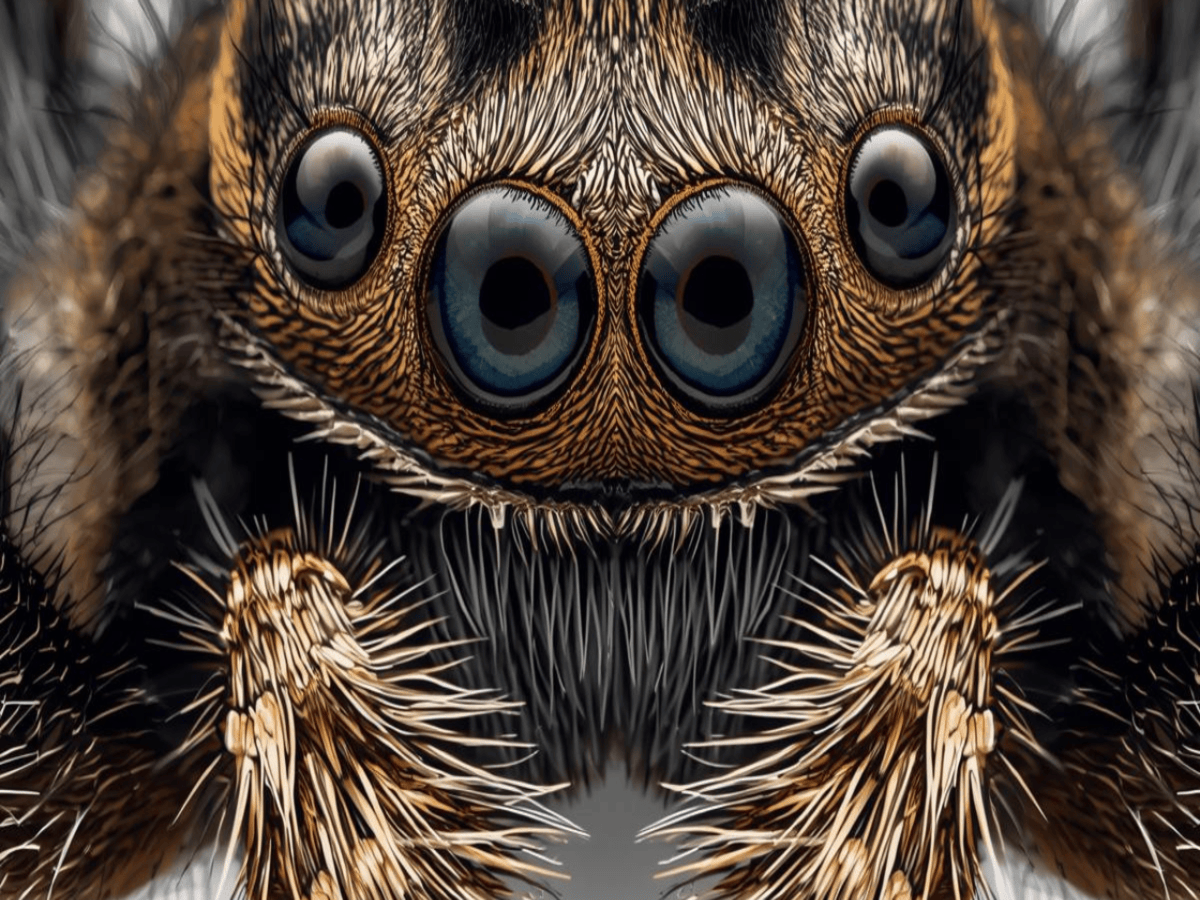
Jumping Spider Eyes: Vision Secrets Explained 2026
Jumping Spider Eyes are one of the most advanced visual systems found in the insect world. These tiny spiders are known for their exceptional eyesight, which helps them hunt, navigate, and react with incredible precision. In the USA, jumping spiders are widely studied and kept as pets due to their unique behavior and intelligence.
Understanding Jumping Spider Eyes is important because their vision is not just simple light detection. Instead, they have a complex multi-eye system that works together to create sharp focus and movement tracking. As a result, they can detect prey from surprising distances compared to their body size.
Additionally, many beginners are surprised to learn how advanced their eyesight really is. For example, jumping spiders can judge distance before jumping, which helps them land accurately on prey. Therefore, their survival depends heavily on visual precision rather than webs or traps.
Moreover, these spiders are often compared to miniature camera systems due to their clarity and motion detection abilities. In fact, researchers in the USA have studied their vision to understand robotics and artificial vision systems.
This guide will help you understand everything about Jumping Spider Eyes in a simple and practical way. For example, you will learn how many eyes they have, how color vision works, and why their eyesight is considered one of the best among arachnids.
- Understand how jumping spider vision works
- Learn how many eyes they actually have
- Discover their color and depth perception ability
- Explore real hunting behavior based on vision
Ultimately, learning about their vision gives you a deeper appreciation of how these small hunters survive and thrive in the wild and in captivity.
How Jumping Spider Eyes Work
The structure of Jumping Spider Eyes is one of the most advanced visual systems in the arachnid world. Unlike many other spiders that rely on vibration or web signals, jumping spiders depend heavily on vision. Therefore, their survival is closely linked to how well their eyes function together.
Interestingly, they do not have just one type of vision. Instead, their eyes are divided into main and secondary systems. As a result, each set plays a different role in helping them detect movement, judge distance, and identify prey.
1. Main Eyes (Anterior Median Eyes)
The main eyes are the largest and most powerful part of Jumping Spider Eyes. These eyes provide sharp, high-resolution vision similar to a zoom camera. Therefore, they are responsible for detailed focus and target recognition.
- Provide sharp and detailed central vision
- Used for focusing on prey or objects
- Help in precise jumping and hunting accuracy
Additionally, these eyes can move slightly inside the head, which improves tracking ability. As a result, jumping spiders can follow moving targets with surprising accuracy.
2. Secondary Eyes
Secondary eyes are smaller but extremely important for survival. They act like motion detectors and help the spider stay aware of its surroundings at all times.
- Detect movement from different directions
- Provide wide-angle environmental awareness
- Help identify potential threats quickly
On the other hand, secondary eyes do not provide sharp images. Instead, they function as early warning sensors, allowing the spider to react instantly to danger or prey movement.
How Both Eye Systems Work Together
The combination of main and secondary systems makes Jumping Spider Eyes extremely efficient. For example, secondary eyes detect movement first, and then the main eyes zoom in for a clear focus.
- Secondary eyes detect motion instantly
- Main eyes analyze target details
- Brain coordinates fast response and jumping action
Therefore, this dual system allows jumping spiders to behave like skilled hunters. In fact, their reaction speed and accuracy are considered among the best in the insect world.
Overall, their eye structure is not only unique but also highly efficient for survival, making them one of nature’s most precise visual hunters.
Jumping Spider Eyes How Many and Why It Matters
One of the most common questions about Jumping Spider Eyes is how many eyes they actually have. The answer is simple but fascinating. Jumping spiders have eight eyes arranged in a unique pattern that supports both hunting and survival.
However, not all eyes serve the same purpose. Therefore, understanding the structure helps explain why their vision is so advanced compared to other spiders. In fact, their eye system is one of the most complex among arachnids.
Eight Eyes System Explained
The eight eyes of jumping spiders are divided into four pairs. Each pair has a specific function that contributes to overall visual performance. As a result, they can see both detailed images and wide environmental movement at the same time.
- 2 main central eyes for sharp vision
- 2 forward side eyes for depth support
- 2 lateral eyes for motion detection
- 2 rear side eyes for full environmental awareness
Additionally, this arrangement allows the spider to monitor nearly 360 degrees of its surroundings. Therefore, very few predators or prey can escape unnoticed.
Why Eight Eyes Are Necessary
The number of eyes is directly connected to survival efficiency. For example, jumping spiders rely on vision instead of webs. Therefore, they must detect movement quickly and accurately.
Moreover, each eye pair performs a different task. On the other hand, humans rely on two eyes for all visual tasks, while spiders distribute functions across multiple eyes for better specialization.
- Improves hunting precision and accuracy
- Enhances predator detection speed
- Provides depth and distance calculation
How Jumping Spider Eyes Work Together
The coordination between all eight eyes is what makes Jumping Spider Eyes so powerful. For instance, secondary eyes detect movement first, while main eyes focus on detail.
As a result, the spider can quickly decide whether to attack, escape, or observe. This rapid decision-making system is essential for survival in the wild and in captivity.
In fact, researchers studying vision systems often use jumping spiders as models for robotic vision development. Therefore, their eye structure is not only unique in nature but also valuable in science.
Jumping Spider Eyes Color Vision and Depth Perception
The visual abilities of Jumping Spider Eyes go far beyond simple movement detection. In fact, they can see color, judge depth, and track motion with impressive accuracy. Therefore, their vision is considered one of the most advanced systems among small arachnids.
Additionally, researchers in the USA have found that jumping spiders use a combination of color detection and depth perception to hunt more efficiently. As a result, they are able to make precise decisions in fractions of a second.
Color Vision in Jumping Spiders
Unlike many other spider species, jumping spiders can see a limited but functional range of colors. Therefore, Jumping Spider Eyes color detection plays an important role in identifying prey and surroundings.
- Can detect ultraviolet and green wavelengths
- Helps identify prey movement and patterns
- Supports navigation in natural environments
Moreover, their color vision is not as broad as humans, but it is highly effective for survival. For example, it helps them distinguish between backgrounds and moving insects.
Depth Perception Ability
One of the most impressive features of Jumping Spider Eyes is their ability to judge distance accurately. Therefore, they can perform precise jumps without missing their target.
- Uses both main and secondary eyes for distance calculation
- Improves hunting success rate significantly
- Helps avoid falling or misjudging surfaces
Additionally, their brain processes visual data quickly, allowing near-instant reaction times. As a result, they can calculate the exact distance before attacking prey.
How They See the World
Jumping spiders do not see the world like humans. Instead, their vision is a combination of sharp focus points and motion detection zones. Therefore, their perception is more functional than detailed in a wide field.
For example, the main eyes focus on a single target while other eyes scan for movement. On the other hand, humans rely on a continuous wide image.
Overall, the combination of color detection and depth perception makes Jumping Spider Eyes extremely efficient hunters. In fact, this visual system is one of the key reasons they are so successful in both wild and captive environments.
How Jumping Spider Eyes Help in Hunting
The hunting behavior of jumping spiders is directly powered by Jumping Spider Eyes. Unlike web-building spiders, they rely on active vision and precise movement tracking. Therefore, their eyesight plays a critical role in every attack they make.
In fact, their hunting style is often compared to a tiny predator that calculates distance before striking. Additionally, USA researchers have observed that their success rate depends heavily on visual accuracy and timing.
Step-by-Step Hunting Process
Jumping spiders follow a structured hunting pattern. Therefore, their eyes work together in a highly coordinated system during each stage.
- Secondary eyes detect movement from prey
- Main eyes focus and zoom in on the target
- Brain calculates distance and angle
- Spider prepares for a controlled jump
As a result, their attacks are fast, precise, and highly effective. On the other hand, poor lighting or stress can reduce their accuracy significantly.
Role of Vision in Target Selection
Jumping Spider Eyes are not just for detection. They also help in selecting the right prey. For example, spiders can distinguish between moving and stationary objects.
- Identify movement speed of prey
- Detect size and shape differences
- Avoid unsuitable or dangerous targets
Additionally, they often observe prey for a few seconds before attacking. Therefore, their behavior shows a combination of patience and precision.
Precision Jumping Technique
One of the most impressive abilities is their controlled jump. In fact, their eyes calculate distance so accurately that they rarely miss their target.
Moreover, silk threads are sometimes used as safety lines during jumps. As a result, even failed attempts rarely result in injury.
- Visual depth calculation before jumping
- Muscle coordination guided by eyesight
- Use of silk for safety and stability
Overall, Jumping Spider Eyes are the foundation of their hunting success. Therefore, without this advanced vision system, they would not be able to survive as efficient active predators.
Comparison: Jumping Spider Eyes vs Other Spiders
To fully understand Jumping Spider Eyes, it is important to compare them with other spider species. Unlike web-building spiders, jumping spiders rely heavily on vision for hunting and navigation. Therefore, their eyesight is significantly more advanced and specialized.
Additionally, most spiders depend on vibrations in their webs, while jumping spiders actively track and judge movement visually. As a result, their behavior and survival strategies are completely different.
| Feature | Jumping Spiders | Web-Building Spiders |
|---|---|---|
| Vision Quality | Highly advanced, sharp focus | Weak or limited vision |
| Eye Function | Used for hunting and tracking | Mainly for light and motion detection |
| Hunting Style | Active hunter (visually guided) | Passive hunter (web-based) |
| Depth Perception | Strong and accurate | Very limited |
| Movement Tracking | Highly precise real-time tracking | Minimal tracking ability |
Why Jumping Spider Eyes Are Superior
The structure of Jumping Spider Eyes gives them a major advantage over other spiders. For example, their ability to focus and track prey in real time makes them highly efficient hunters.
Additionally, their multi-eye system allows them to detect movement from multiple directions at once. Therefore, they rarely get caught off guard by predators or escaping prey.
- Better spatial awareness and accuracy
- Faster reaction to movement changes
- Improved hunting success rate
Limitations Compared to Other Species
On the other hand, jumping spiders also have some limitations. For instance, they rely heavily on light and visual clarity. Therefore, poor lighting conditions can reduce their hunting efficiency.
However, despite these limitations, their vision remains one of the most advanced systems among spiders. As a result, they are widely studied in both biology and robotics research.
Overall, this comparison shows that Jumping Spider Eyes are highly specialized for active hunting, unlike other spiders that depend on passive strategies.
Do Jumping Spiders Recognize Humans?
One of the most fascinating aspects of Jumping Spider Eyes is their ability to observe movement in detail. This often leads people to wonder whether they can recognize humans. The answer is more complex than a simple yes or no.
In reality, jumping spiders do not recognize humans in the same way mammals do. However, they can detect patterns, movement, and repeated behavior. Therefore, they may appear to “recognize” their owner over time.
How They Respond to Humans
Jumping spiders rely heavily on their vision, especially motion detection. As a result, they react strongly to nearby movement, including human interaction.
- Track hand movement near the enclosure
- React to sudden motion changes
- Observe repeated activity patterns
Additionally, many USA hobbyists report that their spiders become less defensive over time. Therefore, this behavior is often interpreted as familiarity.
Can Jumping Spider Eyes Identify Faces?
Jumping Spider Eyes are highly advanced, but they do not function like human facial recognition. Instead, they focus on shapes, motion, and light contrast.
- No true facial recognition ability
- Strong motion-based pattern detection
- Ability to distinguish environment changes
On the other hand, they may learn to associate certain movements with safety or feeding. As a result, they may behave calmly when they detect familiar patterns.
Myths vs Facts
There are many myths about jumping spiders interacting with humans. Therefore, it is important to separate facts from assumptions.
- Myth: They recognize human faces clearly
- Fact: They recognize movement patterns instead
- Myth: They form emotional bonds
- Fact: They respond based on behavior and environment
Additionally, their reactions are based on survival instincts rather than emotional attachment. However, their curiosity and behavior often make them appear more intelligent than other spiders.
Overall, Jumping Spider Eyes provide excellent visual awareness, but their interaction with humans is based on observation and learning patterns rather than true recognition.
Conclusion: The Incredible Power of Jumping Spider Eyes
The study of Jumping Spider Eyes reveals just how advanced nature can be, even in tiny creatures. These spiders rely on a highly specialized vision system that combines sharp focus, motion detection, and depth perception.
Additionally, we learned that their eight-eye system works in perfect coordination. Therefore, they can hunt with precision, avoid predators, and interact with their environment more effectively than most other spiders.
In fact, their visual abilities have inspired scientific research in robotics and artificial intelligence. As a result, jumping spiders are not only fascinating pets but also important subjects in modern science.
Moreover, their ability to detect movement, judge distance, and observe surroundings makes them one of the most visually intelligent arachnids. On the other hand, they still rely on instincts rather than emotions or human-like recognition.
Overall, understanding Jumping Spider Eyes gives us a deeper appreciation of how these small hunters survive and thrive in both wild and captive environments.
If you want to explore more about jumping spider behavior and care, continue learning from expert guides and improve your knowledge step by step.
Start your journey today and discover the hidden world of jumping spider vision.
Frequently Asked Questions (FAQs)
1. Jumping spider eyes how many do they have?
Jumping spiders have eight eyes arranged in four pairs. Each pair has a different role, including motion detection, depth perception, and sharp central vision.
2. What makes jumping spider eyes so special?
Their eyes provide advanced vision with excellent focus, movement tracking, and depth perception, making them one of the best visual systems among spiders.
3. Can jumping spiders see color?
Yes, jumping spiders can see limited colors such as green and ultraviolet, which helps them identify prey and navigate their environment.
4. Do jumping spiders have good eyesight?
Yes, they have extremely good eyesight compared to other spiders. Their main eyes provide sharp vision similar to a zoom lens.
5. Can jumping spiders recognize humans?
They cannot recognize human faces, but they can respond to movement patterns and may become familiar with repeated activity.
6. How far can jumping spiders see?
They can detect movement from several body lengths away, depending on lighting and environment conditions.
7. Why do jumping spiders have big front eyes?
Their large front eyes help them focus sharply on prey, judge distance accurately, and perform precise jumping attacks.
