
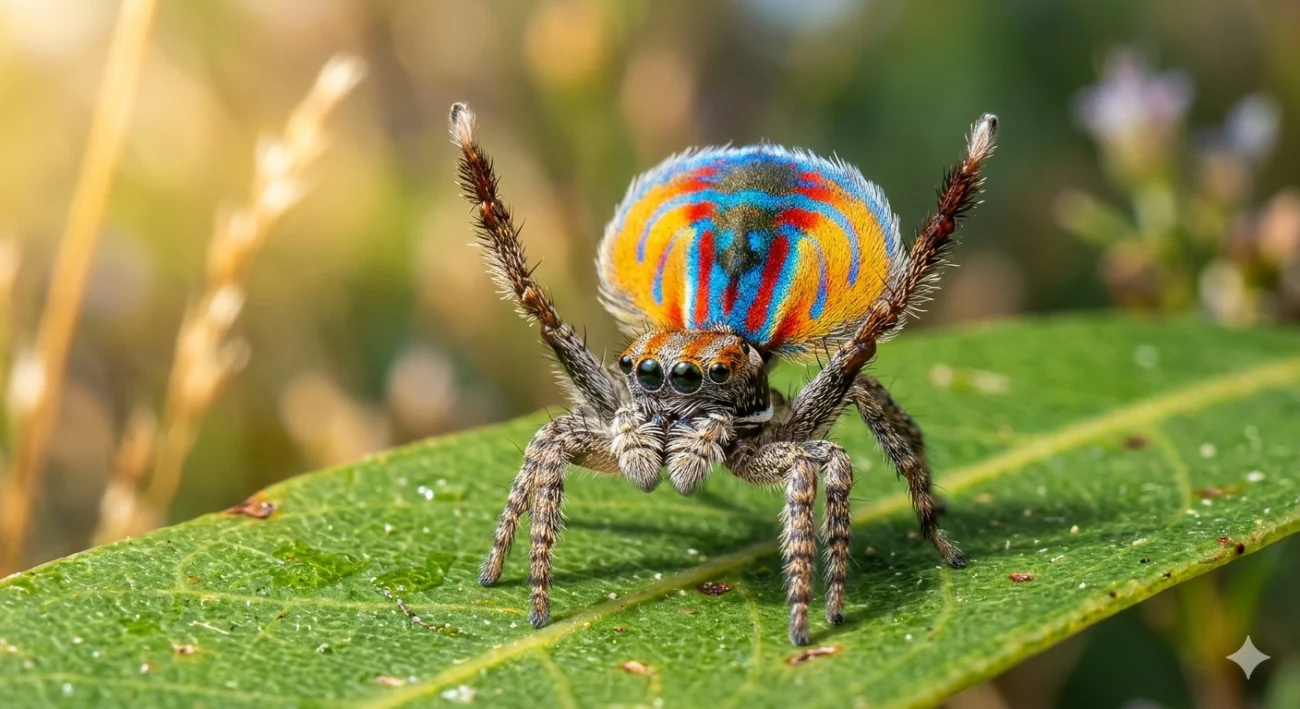
Peacock Spider Dance Explained: A Fascinating Natural Behavior
The Peacock Spider Dance is one of the most visually stunning courtship behaviors in the animal kingdom. Many people in the USA discover this phenomenon through viral videos and become curious about its meaning. However, this behavior is not random or entertaining movement. Instead, it plays a critical role in spider survival and reproduction.
In fact, the Peacock Spider Dance is performed by male peacock spiders to attract females during mating season. These tiny spiders use color, movement, and vibration to communicate. Additionally, their performance is surprisingly complex for such a small creature.
Unlike dangerous spiders, peacock spiders are harmless to humans. Therefore, their behavior is studied mainly for scientific interest rather than concern. As a result, researchers in Australia and around the world find them valuable for understanding animal communication.
This article will explain everything about the Peacock Spider Dance in a simple and structured way. Additionally, you will learn how the dance works, why it happens, and what makes it unique among spider species.
- Understand what peacock spiders are and where they live
- Learn why the dance behavior exists in nature
- Explore how males attract females using movement and color
- Discover interesting scientific facts and comparisons
Therefore, by the end of this guide, you will clearly understand the purpose and beauty of this behavior. Instead of seeing spiders as frightening, you will recognize them as complex and fascinating creatures.
Let’s begin by understanding what peacock spiders actually are and why they are so unique in the animal world.
What Are Peacock Spiders?
To fully understand the Peacock Spider Dance, it is important to first know what peacock spiders actually are. Peacock spiders belong to the genus Maratus, a group of tiny jumping spiders known for their bright colors and unique courtship behavior.
Additionally, these spiders are native to Australia and are not commonly found in the USA. However, they have gained global attention due to their dramatic mating displays shared widely on social media and science platforms.
Key Characteristics of Peacock Spiders
- Very small size, usually 2 to 5 millimeters
- Bright, colorful abdominal patterns in males
- Excellent vision compared to most spiders
- Highly active daytime hunters
- Complex courtship behavior known as the dance
On the other hand, female peacock spiders are usually dull in color. This difference helps males stand out during the Peacock Spider Dance. Therefore, color plays a major role in attracting mates.
Habitat and Natural Environment
In fact, peacock spiders are mostly found in dry, sunny regions of Australia. For example, they live in:
- Grasslands and shrubs
- Forest floors with dry leaves
- Open sandy areas
Additionally, they prefer environments where small insects are available for hunting. As a result, they are active predators despite their tiny size.
Unlike many spiders, they do not build large webs. Instead, they rely on speed, vision, and jumping ability to capture prey. Therefore, they belong to the jumping spider family, which is known for intelligence and agility.
Why They Are So Popular
On the other hand, peacock spiders became famous because of their unique appearance and behavior. Their colorful patterns combined with the Peacock Spider Dance make them look almost like tiny performers.
Additionally, high-quality macro photography and videos have made them viral across platforms like YouTube and science documentaries. Therefore, they are now one of the most recognized spiders worldwide.
As a result, understanding their background helps explain why their courtship behavior is so important in nature.
Next, we will explore the actual meaning and purpose behind the Peacock Spider Dance.
What Is the Peacock Spider Dance?
The Peacock Spider Dance is a unique courtship display performed by male peacock spiders during mating season. It is one of the most advanced and visually striking behaviors found in such a small arachnid.
Additionally, this dance is not random movement. Instead, it is a highly structured sequence of visual and vibrational signals designed to attract female spiders. Therefore, every motion has a purpose in communication.
How the Dance Begins
In fact, the process starts when a male detects a nearby female. Once he identifies her presence, he carefully approaches while preparing his display. As a result, timing plays a critical role in success.
- The male raises his front legs
- He exposes his colorful abdominal flap
- He begins rhythmic body movements
- He produces subtle ground vibrations
However, if the female is not interested, she may ignore or even reject the male immediately. On the other hand, if she responds positively, the dance continues with more intensity.
Visual Signals in the Dance
The most important part of the Peacock Spider Dance is visual communication. Males use bright colors and movement patterns to gain attention. For example, they may flash vibrant blue, red, or orange markings on their abdomen.
Additionally, they wave their legs in synchronized patterns. Therefore, the dance resembles a miniature performance designed to impress.
Vibrations and Sound Communication
In addition to visual signals, peacock spiders also use vibrations. These vibrations travel through the ground and are detected by the female.
As a result, the dance becomes a multi-sensory communication system. It includes:
- Visual signals (color and movement)
- Vibrational signals (ground communication)
- Timing and rhythm coordination
However, this combination does not guarantee success. Female spiders are highly selective and only choose the strongest and most impressive males.
Why This Behavior Matters
Therefore, the Peacock Spider Dance is not just a performance. It is a survival strategy. Males that fail to impress do not get a chance to reproduce, while successful ones pass on their genes.
In fact, this behavior helps scientists understand how communication evolved in small animals. It also shows that even tiny creatures can have complex social interactions.
Next, we will explore why peacock spiders perform this dance and what drives this fascinating behavior in nature.
Why Do Peacock Spiders Dance?
The Peacock Spider Dance exists for one main reason: reproduction. Male peacock spiders perform this behavior to attract females and successfully mate. However, the process is not simple. Females are extremely selective, so only the most impressive males succeed.
Additionally, this dance is a survival-based behavior shaped by evolution. Over time, males that performed better courtship displays had higher chances of reproducing. As a result, the behavior became more complex and visually striking.
Attracting a Mate
In fact, the primary purpose of the Peacock Spider Dance is to attract female attention. Males use bright colors, leg movements, and vibrations to stand out in their environment.
- Bright abdominal patterns signal health and strength
- Rhythmic movements show coordination
- Vibrations help communicate intent
However, females do not respond to all males equally. Instead, they evaluate each performance carefully before making a decision.
Natural Selection in Action
On the other hand, this behavior is a clear example of natural selection. Only males with the best combination of color, movement, and timing are chosen by females.
Therefore, the Peacock Spider Dance is not just decoration. It directly affects survival and genetic success.
Additionally, weaker or less attractive males often get ignored or rejected. As a result, they do not pass on their genes to the next generation.
Communication Beyond Words
Unlike humans, peacock spiders do not use sound or language. Instead, they rely on visual and vibrational communication. This makes their dance extremely important for survival.
- Visual signals: colors and movement patterns
- Vibrational signals: ground-based communication
- Behavioral signals: timing and repetition
In fact, researchers believe this combination makes the Peacock Spider Dance one of the most advanced communication systems among spiders.
Evolutionary Advantage
Therefore, this dance provides a strong evolutionary advantage. Males that perform better are more likely to reproduce, ensuring their traits continue in future generations.
Additionally, this explains why different peacock spider species have slightly different dance styles. Over time, each species developed unique patterns based on environmental and mating pressures.
Next, we will break down the exact movements and behavior steps involved in the Peacock Spider Dance in detail.
Peacock Spider Dance Behavior Explained
The Peacock Spider Dance is not a single movement. Instead, it is a carefully structured sequence of actions performed by male spiders. Each step plays a specific role in attracting a female and increasing mating success.
Additionally, scientists studying this behavior in Australia have observed that timing, rhythm, and precision are extremely important. Therefore, even small mistakes can reduce mating chances significantly.
Step-by-Step Dance Sequence
In fact, the dance usually follows a predictable pattern once a male detects a female nearby.
- Step 1: The male spots a female using his strong vision
- Step 2: He approaches slowly and carefully
- Step 3: He raises his front legs high
- Step 4: He expands and displays his colorful abdomen
- Step 5: He begins rhythmic side-to-side movements
- Step 6: He adds vibration signals through the ground
However, the female may interrupt at any point. On the other hand, if she remains still and attentive, the male continues his performance with increased intensity.
Role of Timing and Rhythm
Timing is extremely important in the Peacock Spider Dance. For example, a male that moves too fast may scare the female. Additionally, slow or uncoordinated movements can reduce attraction.
Therefore, successful males maintain a perfect balance between speed and control. As a result, their movements appear smooth and intentional.
Female Response Behavior
In fact, female peacock spiders play an active role in this process. They carefully observe each male before making a decision.
- They may stay still if interested
- They may move closer for inspection
- They may reject the male by walking away or attacking
Additionally, females prefer males with stronger visual signals and better coordination. Therefore, the dance becomes a test of quality rather than just attraction.
Scientific Observations
Researchers have found that the Peacock Spider Dance varies slightly between species. However, the core structure remains the same across all peacock spiders.
On the other hand, environmental conditions such as light, temperature, and habitat can influence performance. As a result, no two dances are exactly identical.
Why This Behavior Is So Advanced
In fact, this behavior is considered one of the most advanced courtship displays in the arachnid world. It combines:
- Visual communication through color
- Physical movement coordination
- Vibration-based signaling
Therefore, the Peacock Spider Dance shows how even tiny creatures can develop complex communication systems.
Next, we will discuss whether peacock spiders are dangerous and if their behavior poses any risk to humans.
Are Peacock Spiders Dangerous?
One of the most common concerns about the Peacock Spider Dance is whether these spiders are dangerous to humans. The simple answer is no. Peacock spiders are completely harmless to people and pets.
Additionally, despite their bright colors and dramatic movements, they do not pose any medical risk. In fact, they are among the least harmful spiders in the world.
Are Peacock Spiders Harmful to Humans?
In reality, peacock spiders are too small to cause any serious harm. Even if they attempt to bite, their fangs are not strong enough to penetrate human skin in most cases.
- No known toxic venom to humans
- No aggressive behavior toward people
- Rare and harmless contact cases
Therefore, the Peacock Spider Dance is purely a natural mating behavior and not a warning sign of danger.
Do Peacock Spider Bites Hurt?
On the other hand, bites from peacock spiders are extremely rare. However, if a bite does occur, it is usually harmless and may feel like a mild pinprick at most.
Additionally, there are no recorded cases of serious reactions in humans. As a result, they are considered safe even in close encounters.
Are They Dangerous to Pets?
In fact, peacock spiders are also not harmful to pets such as cats or dogs. Their small size and weak venom make them insignificant in terms of pet safety.
- No toxic effect on cats
- No danger to dogs
- They are often ignored by pets
Therefore, pet owners in the USA do not need to worry about encountering these spiders indoors or outdoors.
Why People Think They Are Dangerous
However, many people assume they are dangerous because of their appearance. Their bright colors and dance-like movements can look unusual or intimidating at first.
Additionally, the word “spider” often creates fear. As a result, harmless species like peacock spiders are misunderstood.
Scientific Safety Perspective
Researchers confirm that the Peacock Spider Dance has nothing to do with aggression or defense. Instead, it is strictly related to reproduction.
Therefore, scientists often use them as examples to educate people about non-dangerous spider species.
Next, we will explore some interesting and lesser-known facts about peacock spiders that make them even more fascinating.
Interesting Facts About Peacock Spiders
The Peacock Spider Dance has made these tiny creatures famous worldwide, but there is much more to them than just their performance. Peacock spiders are full of surprising biological and behavioral traits that make them unique in the animal kingdom.
Additionally, scientists continue to discover new species and behaviors, especially in Australia. Therefore, our understanding of these spiders is still growing.
1. Extremely Small but Visually Powerful
In fact, peacock spiders are only a few millimeters long. However, their colors and movements make them appear much larger in videos and images.
- Size: 2–5 mm on average
- Bright, reflective abdominal patterns
- Highly detailed courtship visuals
As a result, they are often mistaken for larger spiders in photos.
2. Males Are More Colorful Than Females
On the other hand, male peacock spiders are significantly more colorful than females. This difference is essential for mating success during the Peacock Spider Dance.
Females usually have dull brown or grey tones, which help them stay hidden from predators while they observe males.
3. They Don’t Use Webs to Hunt
Unlike many other spiders, peacock spiders do not rely on webs to catch prey. Instead, they actively hunt small insects.
- They jump to capture prey
- They use strong eyesight for targeting
- They rely on speed and agility
Therefore, they are more like tiny hunters than web builders.
4. Their Vision Is Extremely Advanced
In fact, peacock spiders have some of the best vision among all spiders. This is important for both hunting and performing the Peacock Spider Dance.
Additionally, their eyes help them judge distance, detect movement, and identify potential mates.
5. Many New Species Are Still Being Discovered
Researchers in Australia continue to discover new peacock spider species regularly. As a result, the total number of known species is constantly increasing.
Therefore, it is likely that more variations of the dance behavior will be found in the future.
6. Their Dance Can Go Viral
In fact, videos of the Peacock Spider Dance often go viral on social media due to their colorful and energetic display.
- Popular on YouTube science channels
- Shared widely on educational platforms
- Used in biology awareness content
As a result, they have become one of the most recognizable spiders in the world.
7. They Are Completely Harmless
Most importantly, peacock spiders are harmless to humans. They do not pose any danger and are not aggressive.
Therefore, they are admired rather than feared by scientists and nature enthusiasts.
Next, we will compare peacock spiders with other jumping spiders to understand their uniqueness even better.
Peacock Spider vs Other Jumping Spiders
To better understand the Peacock Spider Dance, it is useful to compare peacock spiders with other jumping spider species. Although they belong to the same family, their behavior, appearance, and courtship style can be very different.
Additionally, this comparison helps explain why peacock spiders are considered one of the most visually advanced spiders in the world. Therefore, their popularity is much higher than most related species.
Key Differences Overview
| Feature | Peacock Spiders | Other Jumping Spiders |
|---|---|---|
| Color Pattern | Bright, metallic, and decorative | Usually brown, grey, or simple patterns |
| Courtship Behavior | Complex Peacock Spider Dance | Simple leg waving or vibration |
| Popularity | Very high due to viral videos | Moderate scientific interest |
| Habitat | Mainly Australia | Worldwide distribution |
| Visual Signals | Highly advanced color display | Limited visual display |
Behavioral Differences
In fact, the biggest difference lies in courtship behavior. The Peacock Spider Dance is far more complex compared to typical jumping spider signals.
- Peacock spiders use multi-step dance routines
- Other jumping spiders use simpler movements
- Peacock spiders rely heavily on visual attraction
On the other hand, both types of spiders share strong hunting abilities and excellent vision. Therefore, they are equally skilled predators in their environments.
Appearance and Visual Appeal
Additionally, peacock spiders are far more colorful than most jumping spiders. Their abdominal flaps display vibrant patterns that reflect light in unique ways.
As a result, they are often used in photography, documentaries, and educational content.
Scientific Importance
In fact, both groups are important for scientific research. However, peacock spiders receive more attention due to their unique mating display.
Therefore, the Peacock Spider Dance has become a key subject in studies of animal behavior and evolution.
Conclusion of Comparison
Overall, while all jumping spiders share similar biological traits, peacock spiders stand out due to their extraordinary courtship behavior and visual presentation.
Next, we will explore real-world experiences, observations, and insights shared by people who have studied or encountered these fascinating spiders.
Real Observations and Expert Insights on Peacock Spiders
The Peacock Spider Dance has not only fascinated scientists but also nature enthusiasts across the USA and around the world. Although these spiders are native to Australia, many researchers and photographers have documented their behavior in controlled environments and field studies.
Additionally, these real-world observations help us understand how complex and intelligent even tiny spiders can be. Therefore, expert insights play an important role in explaining their behavior clearly.
Scientific Observations
In fact, arachnologists studying jumping spiders have noted that peacock spiders show unusually advanced courtship patterns. Their behavior is often compared to miniature performance displays.
- Researchers observe precise movement coordination
- Male spiders adjust behavior based on female response
- Different species show unique dance variations
On the other hand, scientists also highlight that environmental conditions can affect the intensity of the Peacock Spider Dance. For example, lighting and habitat structure may influence visibility and success rates.
Photographer Experiences (USA-Based Observations)
Additionally, macro photographers in the USA who study exotic insects in controlled habitats often describe peacock spiders as “living artwork.” Their movements appear highly choreographed when captured on high-resolution lenses.
For example, wildlife photographers report:
- Surprise at their extremely small size
- Difficulty capturing fast dance movements
- High interest from educational audiences
Therefore, the Peacock Spider Dance is widely used in educational documentaries and biology presentations.
Educational and Academic Feedback
In fact, biology educators often use peacock spiders as a real-world example of animal communication. Students find their behavior easier to understand compared to more complex species.
Additionally, teachers highlight the following learning points:
- Natural selection and mating success
- Visual communication in animals
- Evolution of courtship behavior
General Public Reactions
On the other hand, general audiences often react with surprise when first seeing the Peacock Spider Dance. Many people do not expect such complex behavior from a tiny spider.
As a result, videos of their dance often receive millions of views online, especially on educational and science-focused platforms.
Trust and Scientific Consensus
Therefore, the scientific community agrees that peacock spiders are harmless, fascinating, and highly valuable for behavioral research. Their dance is not just visually impressive but also scientifically important.
Next, we will conclude the article with a strong summary and practical call-to-action for readers interested in learning more.
Conclusion: Understanding the Peacock Spider Dance
The Peacock Spider Dance is one of the most remarkable examples of animal behavior in nature. It combines color, movement, and vibration into a highly structured courtship display. Therefore, it is not just a visual performance but a key survival mechanism.
Additionally, this behavior shows how even the smallest creatures can develop complex communication systems. Peacock spiders rely on precision, timing, and visual signals to attract mates successfully. As a result, only the strongest males pass their genes to the next generation.
Key Takeaways
- Peacock spiders use dance for mating, not aggression
- Their behavior is safe and harmless to humans
- Color and movement play a major role in attraction
- Each species has unique variations of the dance
In fact, understanding the Peacock Spider Dance helps us appreciate biodiversity and the complexity of insect life. On the other hand, it also challenges common fears about spiders by showing their harmless and fascinating nature.
Additionally, this knowledge is valuable for students, researchers, and nature lovers who want to explore animal behavior more deeply.
Why This Matters
Therefore, peacock spiders are not just interesting creatures. They are important examples of evolution, communication, and natural selection in action. Their dance continues to inspire scientists and educators worldwide.
If you enjoyed learning about the Peacock Spider Dance, explore more fascinating spider behavior guides on JumpingSpider.xyz. Additionally, stay updated with new discoveries about jumping spiders and their unique survival techniques.
Discover more, learn deeper, and see how nature creates some of the most incredible behaviors in the animal world.
FAQs About Peacock Spider Dance
1. What is the Peacock Spider Dance?
The Peacock Spider Dance is a courtship behavior where male peacock spiders perform colorful movements to attract females. It includes leg waving, body vibrations, and bright visual displays.
2. Why do peacock spiders perform a dance?
They perform the dance to attract a mate. Additionally, it helps females choose the strongest and healthiest male based on movement, color, and timing.
3. Are peacock spiders dangerous to humans?
No, peacock spiders are completely harmless. They are too small to cause any serious harm and are not aggressive toward humans.
4. Can a peacock spider bite hurt?
A bite from a peacock spider is extremely rare and usually feels like a very mild pinch. It is not medically dangerous.
5. Where are peacock spiders found?
Peacock spiders are mainly found in Australia. They live in dry grasslands, forests, and sandy areas with good sunlight.
6. Are peacock spiders smart?
Yes, they are considered intelligent for their size. They use advanced vision and complex behavior patterns during hunting and courtship.
7. Why is the peacock spider dance so popular?
The dance is popular because of its bright colors, unique movements, and viral videos. It looks like a tiny performance, making it very engaging and educational.
